

Hey, Ross here:
Hope you had a relaxing Labor Day weekend. Let’s jump right back into the trading week with another actionable trade idea.]
This time, we’re going back to the long side.
Chart of the Day
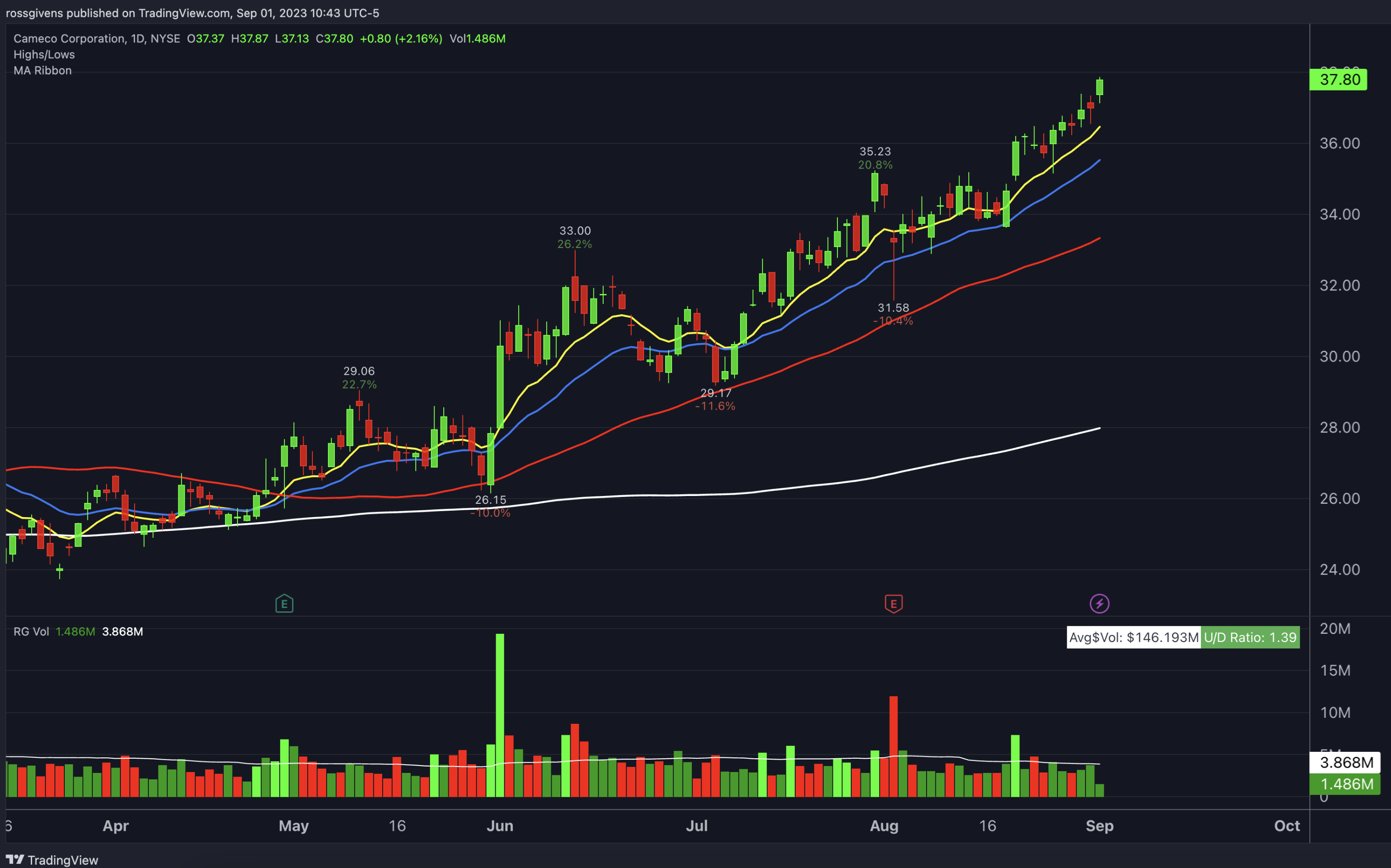
Uranium, cybersecurity, oil & gas, biotechnology, and software stocks are currently the best performers. So, I want to focus on the best stocks in those groups.
This simple process reduces 6,000+ publicly traded stocks down to a watchlist of 20-30. And that is where I focus.
Cameco Corp (CCJ) is a beautiful trending stock ripping to new highs.
I only have three words to say about this – I like it.
Insight of the Day
Your win/loss ratio is more important than your win rate.
Last week, after the selloff in NVDA stock following a blowout earnings report and an accompanying decline in the Nasdaq, I was nearly certain the market would fall further this week.
It did not. I was wrong. And, unfortunately, that is part of the game.
Trading is a game of probabilities. You are going to pick losing stocks. That’s why you should always be tracking your win rate and win/loss ratio.
Most people focus exclusively on win rate. I get asked about my win rate all the time on webinars.
But that’s only the lesser half of the equation.
I’ve seen traders with win rates over 80% that still lose money. There are charlatans in my line of work who tout huge win rates and claim to have “96% winning trades.”
Here’s the part they don’t tell you…
The other 4%? That tiny number of losing trades? They wipe out all the gains.
Why? Their win/loss ratio is horrible.
The win/loss ratio represents your edge. It is the ratio of your average profit against your average loss.
If your winning trades have an average profit of 12% and your losers average only -4%, your win/loss ratio is 3:1. In other words, you make three times as much money when you are right as you lose when you are wrong.
This is extremely important. Because your win/loss ratio dictates how often you need to win.
In the above example, a 3:1 win/loss ratio means you only need to be right 25% of the time. Every win offsets three losses, so as long as you can get 1 out of 4 right, you are not losing money. Any better than that, and your account balance is growing.
But if those numbers were reversed – say your average profit is 4% but your average loss is -12% – your win loss ratio would be 1:3. Now you need to be right 75% of the time, since one losing trade wipes out three winning ones.
That’s much harder to do.
That’s why I focus so much on win/loss ratios – and why I insist on stop losses for every trade I recommend.
And right now, I’m going LIVE to showcase a strategy that targets the highest win/loss ratios of them all…
Because it focuses on finding stocks with hidden catalysts that could deliver triple to even quadruple-digit gain.
So click here to join me in the live room now…
And I’ll explain everything.
Embrace the surge,

Ross Givens
Editor, Stock Surge Daily
See more from Traders Agency on Google
Make us a preferred source and our market analysis will appear more prominently in your Google Search, Top Stories, and AI results.
Add to Preferred Sources