
Alibaba Group reported quarterly results for the period ended September 30, 2026, showing total revenue of RMB271,519 million (US$40,498 million), up 10% year-over-year, driven in large part by a 53% jump in AI Cloud and Compute Services revenue, according to the company's official results release. At the same time, the company's e-commerce segment posted sharply improved profitability, even as heavy AI infrastructure investment weighed on free cash flow and, according to Seeking Alpha, on per-share earnings.
AI Cloud Revenue Accelerates on AI Demand
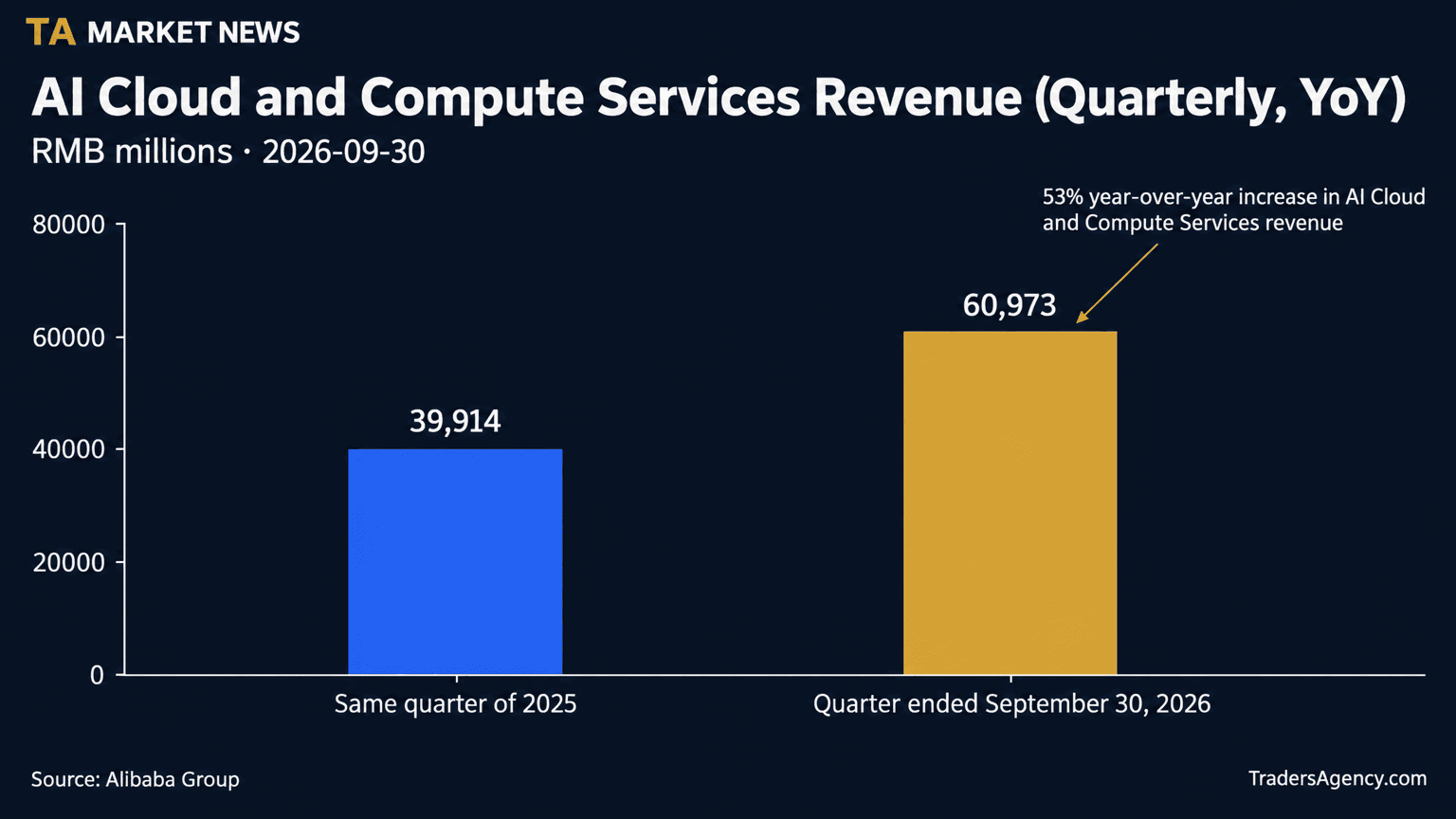
Alibaba's AI Cloud and Compute Services revenue reached RMB60,973 million (US$9,094 million) in the quarter, up from RMB39,914 million a year earlier, a 53% year-over-year increase, according to Alibaba's own results release. The company said AI-related product revenue hit RMB17,918 million, marking the thirteenth consecutive quarter of triple-digit year-over-year growth, with demand spread across internet, automotive, embodied AI, financial services and biotechnology customers, per the same release.
Management framed the growth as broad-based. CEO Eddie Wu said the company would continue bringing technological innovations to its AI stack to meet what he called "strong and diverse AI demands across industries," according to Alibaba's results statement. The release also noted that beyond training and inference demand from AI labs, the company continues to see robust demand from customers in China's emerging innovation economy, including electric vehicles, embodied AI, and biotechnology.
E-commerce Profitability Improves Sharply
Alibaba E-commerce Group's adjusted EBITA rose 243% year-over-year to RMB38,851 million in the quarter, up from RMB11,336 million a year earlier, which the company attributed primarily to improved operating performance in Taobao Instant Commerce and various commerce businesses, according to the results release. CFO Toby Xu said the segment delivered significant EBITA growth driven by improving unit economics in quick commerce and solid growth in marketplace e-commerce. Wu added that quick commerce continued to narrow its losses substantially while maintaining market share.
Revenue growth in the e-commerce segment was far more modest than the profitability gain. Total Alibaba E-commerce Group revenue rose 2% year-over-year in the quarter to RMB197,237 million, and 3% over the six-month period to RMB403,099 million, per the company's reported figures. China Quick Commerce revenue, driven primarily by Freshippo, rose 22% year-over-year to RMB58,757 million. China e-commerce customer management revenue fell 5% year-over-year, though the company said it would have grown 1% on a like-for-like basis excluding a contra revenue impact tied to a new business development program. International E-commerce revenue declined 8% year-over-year to RMB25,723 million, which Alibaba attributed primarily to AliExpress being affected by the EU Customs Reform, partly offset by growth at Trendyol.
Heavy AI Spending Pressures Cash Flow and Earnings
The AI buildout came with a steep cost. Capital expenditure rose 60% year-over-year to RMB50,477 million, which Alibaba said reflected continued investment in AI infrastructure to meet what it described as strong and accelerating customer demand. Free cash flow for the quarter was an outflow of RMB34,472 million, compared with an outflow of RMB21,840 million a year earlier. The company said the decline in free cash flow was mainly attributed to increased cloud infrastructure expenditure, partly offset by reduced losses in Taobao Instant Commerce and higher customer prepayments for cloud services.
AI Labs and Applications, the unit housing generative AI product development, posted an adjusted EBITA loss of RMB10,503 million in the quarter, widening from a RMB3,435 million loss a year earlier. Alibaba said the wider loss was primarily due to increased AI investment and higher inference costs tied to its Qwen app.
According to Seeking Alpha, higher AI infrastructure spending, AI Labs losses, and quick-commerce spending weighed on per-share earnings and cash flow for the period, even as revenue topped analyst estimates. Seeking Alpha did not quantify the per-share impact, so that characterization is directional rather than a specific reported earnings figure.
Management's Forward Framing
CFO Toby Xu said Alibaba will maintain disciplined investment in AI capabilities with a focus on return on invested capital while targeting positive free cash flow as AI monetization continues to ramp up, according to the company's results statement. Interpreting that framing against the reported figures — capital expenditure up 60% to RMB50,477 million and a quarterly free cash flow outflow of RMB34,472 million — management appears to treat the current outflow as tied to a capacity buildout cycle rather than a structural change, though no timeline for reaching positive free cash flow was given.
Bottom Line
Alibaba's quarter illustrates a split narrative: AI Cloud revenue growth and e-commerce margin improvement on one side, and intensifying capital intensity on the other. The 53% AI Cloud revenue growth and the 243% jump in e-commerce adjusted EBITA both reflect, according to the company's own disclosures, operational improvement in core businesses. At the same time, the 60% rise in capital expenditure and the widened free cash outflow underscore that the AI buildout remains costly in the near term, a tension that Seeking Alpha's reporting ties directly to pressure on per-share earnings even as top-line results beat market expectations.
DISCLAIMER: Traders Agency does not offer financial advice. The information provided is for educational purposes only and should not be considered financial advice. Traders Agency is not responsible for any financial losses or consequences resulting from the use of the information provided. Trading carries inherent risks and may not be suitable for all individuals. You are advised to conduct your own research and seek personalized advice before making any investment decisions, recognizing the potential risks and rewards involved.
- Seeking Alpha Market News: Alibaba revenue tops estimates as AI cloud growth offsets e-commerce weakness · accessed Nov 19, 2026
- Alibaba Group: Alibaba%20Group%20Announces%20September%20Quarter%202026%20Results%20and%20Interim%20Results%20for%20the%20Six%20Months%20Ended%20September%2030%2C%202026.pdf · accessed Nov 19, 2026
See more from Traders Agency on Google
Make us a preferred source and our market analysis will appear more prominently in your Google Search, Top Stories, and AI results.
Add to Preferred Sources