Congress cheats in the stock market. This isn’t a theory. It’s a mathematical reality. The returns these elected officials generate for themselves beat many of the top shops on Wall Street. Year after year, they outperform everyday investors using a remarkably simple method: they take information learned in committee meetings—privileged details about upcoming legislation or government actions—and trade on it.
This pattern repeats annually. Congress outperforms the market pretty much every single year. But the data shows the situation has become far more extreme than most people realize.
The results of the 2025 Congressional Trading Report are in. These aren’t slight outperformance numbers. They’re statistical anomalies that would get any normal citizen investigated.
I want to walk through the average returns, the top performers, and—most importantly—the specific stocks they’re buying. Because once you see the disparity between their portfolios and everyone else’s, you realize the game is rigged.
But that doesn’t mean you can’t play it.
The 2025 Congress Stock Trading Report
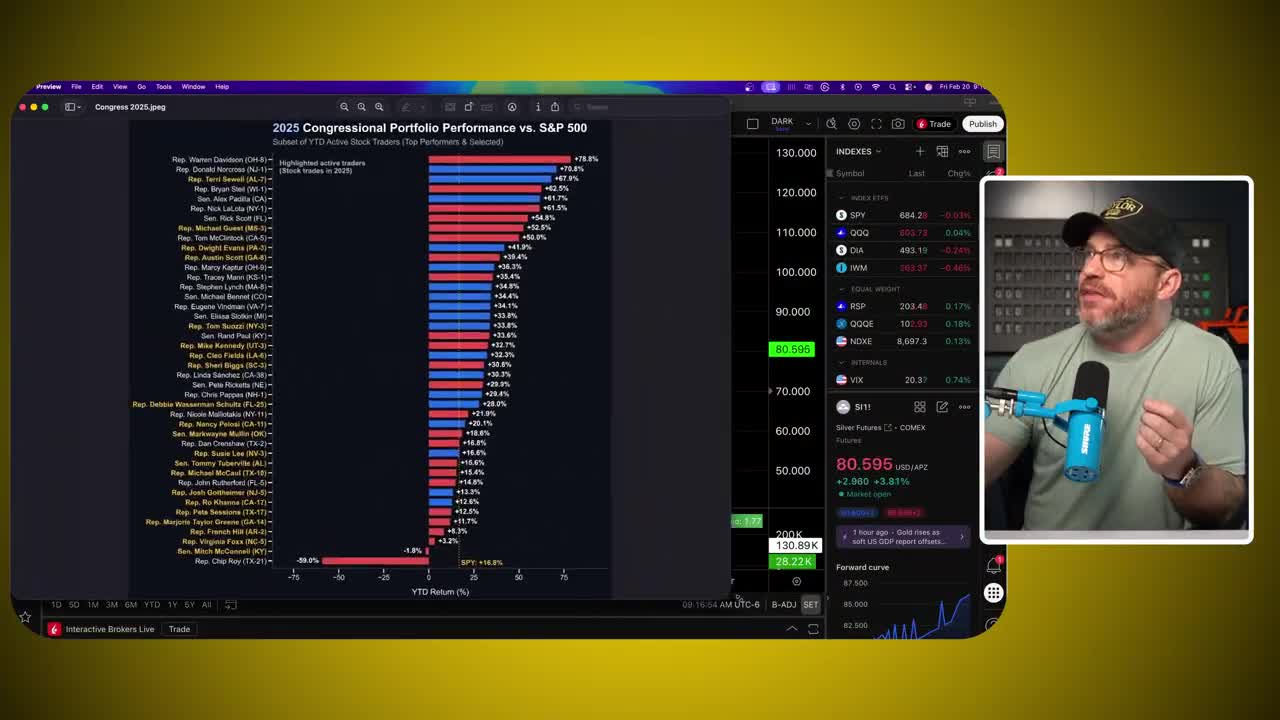
The stock market had a great year in 2025. The S&P 500 returned 16.8%—significantly higher than the long-term average of 9% or 10%.
Dozens of members of Congress slaughtered that number.
Think about that. These aren’t professional stock traders. These aren’t Wall Street hedge funds with multi-million dollar research budgets. These are folks who got elected to Congress placing a couple of trades from their cell phone in their Robinhood account between meetings.
And they aren’t just beating the market by a point or two. They’re generating 50%, 60%, and 70% returns.
Representative Warren Davidson posted a 78.8% portfolio return last year. That’s nearly five times the S&P 500.
A Bipartisan Problem
One common misconception is that this is a political issue specific to one party. The data proves otherwise.
When we break down performance by party, the corruption is evenly distributed:
- Democrats: Average return of 31.8%
- Republicans: Average return of 35%
- S&P 500: Return of 16.8%
Both parties are making roughly double the market index.
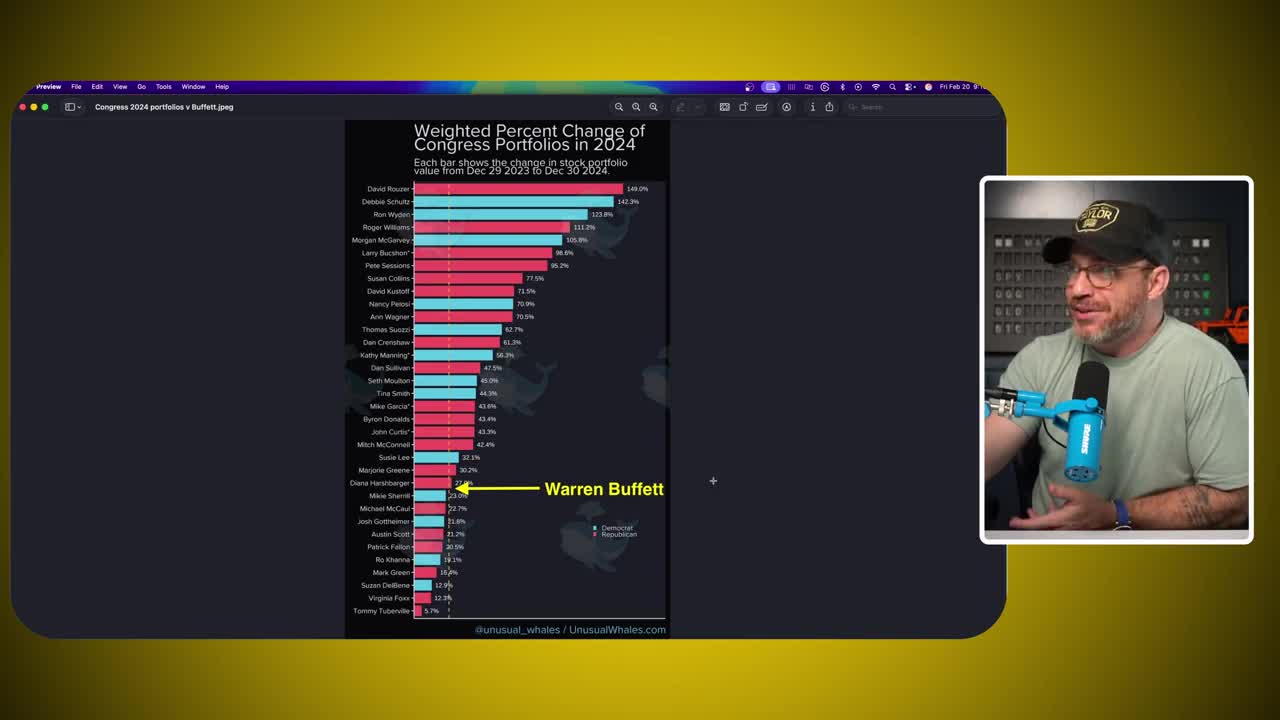
This isn’t a one-year phenomenon either. Data compiled by Unusual Whales for 2024 showed members hitting 50%, 60%, 70%, and in some cases 100-plus percent annual returns.
Warren Buffett had a phenomenal year at around 24%. Yet a significant portion of our legislative body left the Oracle of Omaha in the dust.
Humiliating the Hedge Funds
The data becomes even more shocking when you compare Congressional returns to the people who are actually paid to beat the market: professional hedge funds.
Hedge funds are basically like mutual funds on steroids. They’re only open to institutional investors. They can do anything to generate alpha—buy distressed assets, invest in real estate, trade foreign debt and metals, utilize all kinds of crazy strategies. They’ve got T1 lines right under the exchanges. They employ the smartest quantitative analysts in the world.
The absolute best hedge funds in the world in 2024 generally posted returns of 20% to 25%. That’s phenomenal. A couple funds—not people, entire funds—managed 54%, 59%, or 80%.
Meanwhile, you have a half-dozen members of Congress doubling those returns.
The “Congress Buys” Strategy
Does following them actually work?
There’s a site called Quiver Quantitative that focuses specifically on political trades. They run something called the Congress Buys Strategy. As the name implies, the strategy simply buys the stocks that Congress is buying.
The performance gap is overwhelming.
Since the post-COVID lows of April 2020, the Congress Buys Strategy has generated a 37.4% compounded annual growth rate.
That’s absolutely decimating the market. It confirms these politicians aren’t just lucky. They’re trading on an information advantage that the general public—and even Wall Street—does not have.
Get an entire year of live weekly mentoring sessions, my newsletter, indicators, bonus reports, tons more. Click the link and I’ll see you in the next live session.
Case Study: The Susie Lee Anomaly
How exactly are they doing this? What kind of stocks are they buying?
Thanks to the STOCK Act, they’re required to report these trades publicly. They file two types of reports:
- Periodic Transaction Report (PTR): Filed weeks after a specific trade
- Financial Disclosure Report: Filed annually, showing everything they own
I want to highlight a specific example from Representative Susie Lee to show exactly what to look for.
Susie Lee’s overall holdings aren’t extraordinary. She’s not extremely wealthy. She’s got a little trust with half a million bucks—semi-wealthy, but nothing crazy. She has a rental property in Las Vegas, and a small IRA with a couple hundred thousand dollars. Her portfolio consists of standard positions: an ETF fund, Boyd Gaming, Carnival Cruise, a casino stock. Nothing that raises eyebrows.
She’s not a very active investor. She doesn’t trade a lot compared to other members of Congress.
However, about 18 months ago, a Periodic Transaction Report hit. She bought exactly one stock.
Rheinmetall (Ticker: RNMBY).
This is the key to spotting the corruption. You want to look for the outlier trades.
If she had bought Apple, Nvidia, Google, or Microsoft, there would be no red flags. Everyone owns those mega-caps. But Rheinmetall is a small-cap German arms manufacturer.
That’s an incredibly odd pick for the one stock you buy in a couple of years.
The Result
I don’t want to be a conspiracy theorist, but it seems odd that the single stock this woman bought in three years was a small German arms manufacturer that quadrupled in value over the next year.
It just so happens she also sits on the Military Appropriations Committee—the very committee that doles out big defense contracts to small arms manufacturers like Rheinmetall.
Following the Corporate Donors
This money engine in DC goes even deeper than individual stock trades. This whole corrupt swamp on both sides of the party goes even deeper. You can also spot the trends by looking at where corporate money is flowing.
The top donors to the 2026 midterm elections reveal a clear pattern. These companies don’t take sides. They hedge their bets. They dollar out money to Republicans, Democrats, and Independents across the board. They just want favor.
The top stocks on the donor list: Honeywell, Northrop Grumman, Home Depot, General Dynamics, Boeing, Lockheed Martin.
It’s a list dominated by big defense companies.
And the charts? Honeywell has gone from 190 to 250 just in the last couple of months—pretty much going straight up. Northrop Grumman (NOC) is doing the same thing. Lockheed Martin and Boeing are seeing tremendous moves higher.
These stocks are seeing massive inflows of capital, which just seems overly coincidental given the donor activity.
Tracking the Top Performers
One way to use their corruption to your advantage is to follow the trades of the people who have historically performed the best.
Looking at the 2024 numbers, the top two performers were David Rouzer (149%) and Debbie Schultz (142%).
Debbie Schultz’s recent activity tells an interesting story.
In the last couple of months, she’s been selling off stocks like Ango and VLRS—likely taking profits. But in August, she bought two specific stocks:
- Stratus (SS1Y)
- Icore Holdings (ICR)
While Stratus hasn’t performed great (up only about 8%), look at what happened to Icore.
Buying the stocks they buy, especially from the top performers, puts you in a position to profit right alongside them.
The Death of Reg FD
And the new insider edge
I dug deeper to understand why this gap exists, and I found a comparison involving Warren Buffett that explains everything.
Venture capitalist Chamath Palihapitiya recently discussed a theory regarding Warren Buffett’s returns that’s going to anger a lot of people.
In 2000, a law called Reg FD (Regulation Fair Disclosure) was introduced. The point of Reg FD was essentially that if you’re a CFO, you cannot talk to an individual stock manager and tell him something that you then don’t tell everybody else. Before this, it wasn’t explicitly illegal for a CFO to call a fund manager and say, “Hey, how you doing?” and he goes, “Man, quarter was a blockbuster.” You would go and buy the stock. Starting in the 2000s, it became illegal.
There used to be networks of information arbitrage that took advantage of this.
Warren Buffett’s returns pre-Reg FD were double the market returns. But the minute that information sharing became illegal—when he had to basically act on the same edge as everybody else—his returns went to the market return. He generated zero alpha. In fact, he probably on the margins lost a little bit.
The implication: this is the single best investor in the world. This is what happens when you have information symmetry.
Markets thrive when there’s asymmetry. Billions and billions of dollars will be made in asymmetry.
Congress is the new information arbitrage.
They know what earnings are going to be. They know what drug trial releases are going to be. They know when they’re going to pass legislation that benefits certain stocks. They know when they’re going to go to war and increase defense spending.
Information Is the Commodity
Information is the most valuable commodity on Wall Street.
Those who know more than the general public—those who know what the earnings are going to be, what the drug trial releases are going to be, when they’re going to announce big earnings or big buyouts or mergers—stand to benefit enormously by buying the stock early.
The data from the 2025 Congressional Trading Report proves that our elected officials are using this advantage to generate returns that dwarf the S&P 500 and even the world’s top hedge funds.
My motto has always been to follow the money. Right now, the money is flowing into the accounts of the people writing the laws. You can get angry about it, or you can watch what they’re buying and use that information to your advantage.
Get an entire year of live weekly mentoring sessions, my newsletter, indicators, bonus reports, tons more. Click the link and I’ll see you in the next live session.
DISCLAIMER: Traders Agency does not offer financial advice. The information provided is for educational purposes only and should not be considered financial advice. Traders Agency is not responsible for any financial losses or consequences resulting from the use of the information provided. Trading carries inherent risks and may not be suitable for all individuals. You are advised to conduct your own research and seek personalized advice before making any investment decisions, recognizing the potential risks and rewards involved.
See more from Traders Agency on Google
Make us a preferred source and our market analysis will appear more prominently in your Google Search, Top Stories, and AI results.
Add to Preferred Sources