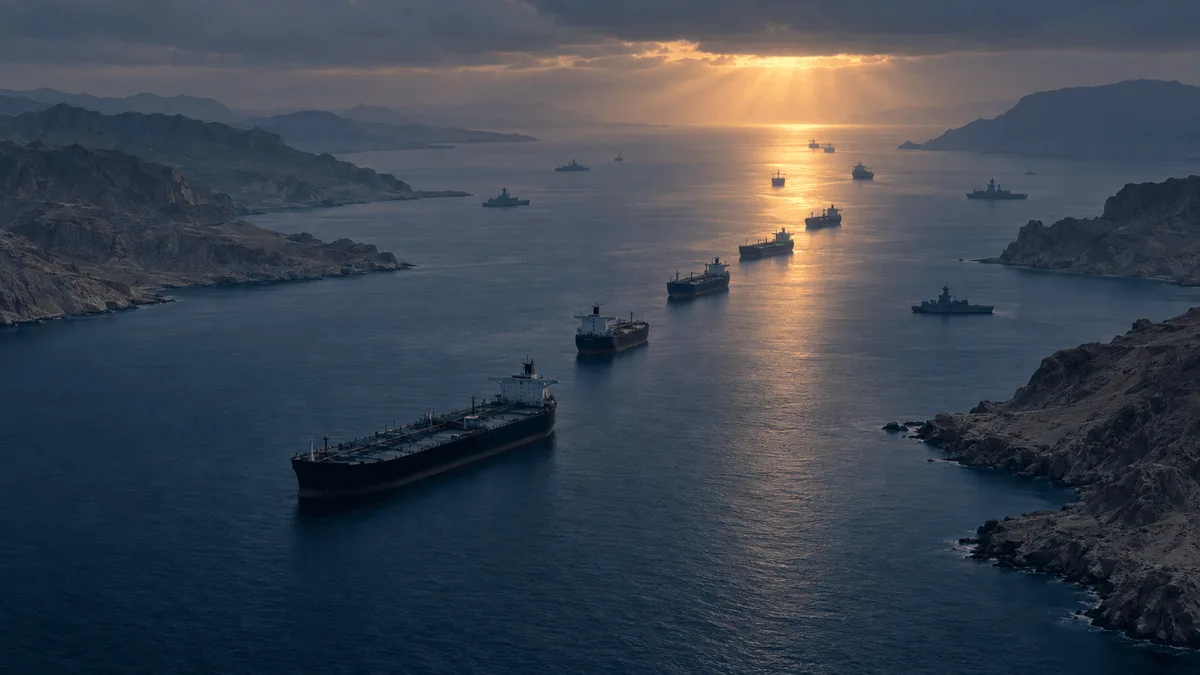
A senior Iranian government official told Kyodo News and Reuters that Iran could reopen the Strait of Hormuz within seven days if the United States eases military pressure and lifts its blockade on Iranian ports, according to reports carried by CNBC, The Straits Times and Channel NewsAsia. The reports rest on a single unnamed source and, CNBC said, could not be independently verified. Oil futures reversed earlier gains and fell to their lowest levels since September 8 after the report, though several other supply developments also weighed on the market the same day.
What Iran Is Offering
According to the official who spoke to Kyodo News, Iran is seeking signs that Washington is prepared to return to negotiations and take steps toward ending the US military blockade of Iranian ports and halting military operations tied to the Strait of Hormuz. If those steps are taken, Iran said it is prepared to reopen the waterway within seven days and return to the negotiating table. The official said "there is a possibility of moving toward an agreement," but added that Washington must demonstrate "seriousness and commitment" for diplomacy to advance.
The proposal has reportedly already been conveyed to Washington through mediators who were not named in the reports. Tehran plans to use this week's United Nations General Assembly gathering in New York to consult with countries acting as intermediaries, and the official told Reuters that the Iranian delegation to the General Assembly has "full authority to revive diplomacy with the United States."
The new initiative was approved by Supreme Leader Mojtaba Khamenei and the Supreme National Security Council, the country's top security body, according to the official. It follows an earlier set of seven conditions Iran presented to Washington on September 19, which Supreme National Security Council Secretary Mohsen Rezaei said included an end to the port blockade and the unfreezing of Iranian assets. The official who spoke to Kyodo News did not say whether the new offer represents a partial relaxation of those seven conditions, so it remains unclear exactly how the two proposals relate to one another.
The offer also arrives against a deadline: according to the official, Iran's Supreme National Security Council decided on August 16 that Tehran would retain the option of carrying out another attack on US forces if Washington does not lift the port blockade within 45 days. The Kyodo report ties Tehran's growing emphasis on diplomacy in part to the toll that port restrictions are taking on Iranian crude exports, one of the country's main revenue sources.
The current war began in late February after US and Israeli attacks on Iran. A US-Iran memorandum of understanding reached in June broke down amid renewed hostilities and unresolved disputes, and commercial shipping through the strait remains far below prewar levels, according to the Straits Times report.
No Confirmed US Response
None of the source reports indicate that the White House, State Department or President Trump has publicly confirmed or responded to the specific reopening proposal. The reports surfaced just before Trump was due to address the UN General Assembly on Tuesday, amid what CNBC described as mounting domestic pressure over his decision to launch the war against Iran. Market attention this week is also focused more broadly on Trump's meetings with world leaders at the General Assembly, set against an unstable Middle East and the ongoing war in Ukraine.
Rather than easing pressure, US policy in the days around the report moved in the other direction on at least one front — an interpretation based on the measures reported below. Treasury Secretary Scott Bessent told CNBC's Squawk Box that all Iranian airlines will be shut down starting Wednesday: "That if they land, you cannot provide them with fuel. You cannot provide them with landing services, you cannot sell them tickets, or you will be knocked out of the dollar system." The Treasury also announced sanctions on Russia's state-controlled VTB Bank last week as part of an effort to economically isolate Iran by targeting its business partners and other financial "enablers," per CNBC.
Separately, the G7 nations condemned what they called "unacceptable continued strikes" by Iranian-backed Houthi rebels against Yemen and Saudi Arabia and called on Iran to end its support for the group. That statement came after Houthi forces seized Yemen's Perim Island, tightening their grip on the Bab el-Mandeb Strait, which CNBC noted puts Iran and its proxies on course to hold sway over two of the world's critical oil choke points at once.
Oil Reverses Lower
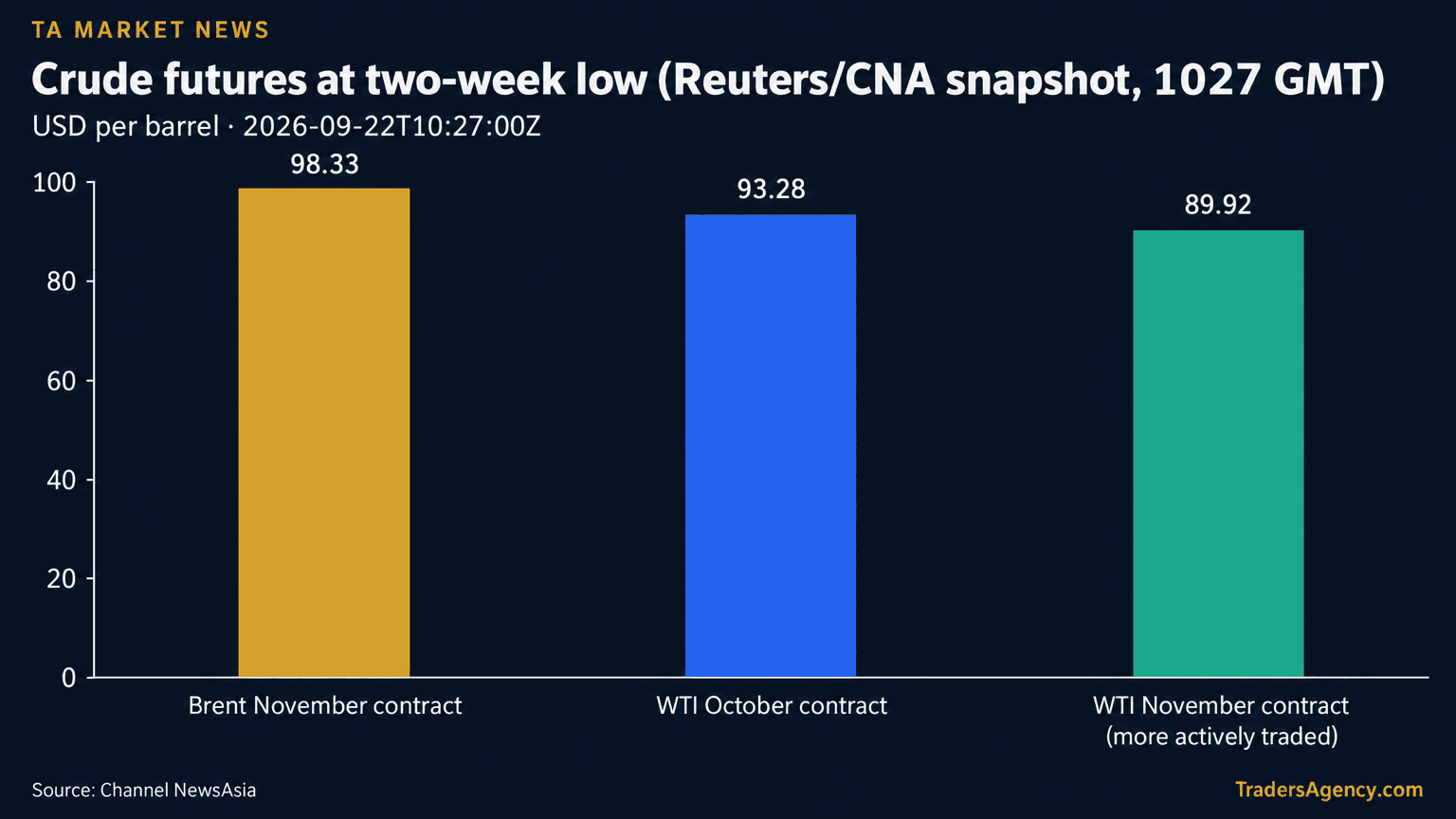
Crude prices swung from gains to losses following the Kyodo report. Brent November, WTI October and WTI November futures all touched their lowest levels since September 8, according to Channel NewsAsia. A CNBC snapshot taken at 6:12 a.m. ET showed Brent for November delivery down 2.75% at $97.58 a barrel, while WTI for October plunged 3.53% to $92.40, easing from a session high of $97.42. A separate snapshot cited by Channel NewsAsia at 1027 GMT showed Brent's November contract down $2.01, or 2%, at $98.33; the expiring WTI October contract off $2.50, or 2.61%, at $93.28; and the more actively traded WTI November contract down $2.45, or 2.65%, at $89.92.
The Hormuz report was not the only factor pressuring prices. Saudi Arabia restarted operations at its East-West Pipeline and could resume exports from the Red Sea port of Yanbu, according to three sources briefed on the matter cited by Channel NewsAsia, with two of them saying the pipeline was running at a low rate. Saudi Aramco has also increased exports through the Strait of Hormuz after attacks on the East-West Pipeline forced it to halt some Yanbu shipments; tanker tracking data showed roughly 14 million barrels of Aramco crude loaded onto seven supertankers inside the Gulf on Sunday.
What Analysts Are Watching
Capital Economics senior climate and commodities economist Hamad Hussain said the price drop "could be a positive sign that diplomacy efforts may be working," while cautioning that "there may also be other obstacles, such as the issue of tolls and fees, to overcome before a lasting solution can be achieved," per Channel NewsAsia. Saxo Bank head of commodity strategy Ole Hansen said he does not see much further downside in oil prices until supply through the strait increases, particularly refined products, which he called where "the real crunch remains." That caution is underscored by diesel prices, which Channel NewsAsia reported have rallied to record highs in Europe and the United States as the wars in Iran and Ukraine have sharply cut exports from major producers including Russia, Saudi Arabia and the UAE.
FXTM analyst Lukman Otunuga told CNBC that "confirmation of direct talks between Washington and Tehran could place additional selling pressure on prices by improving expectations for regional supply," but added that "Tehran has warned that renewed escalation would trigger a significant response, which could push crude prices higher." Before the US-Israeli attacks began in late February, the Strait of Hormuz handled about one-fifth of global oil and liquefied natural gas supplies, a figure both CNBC and Channel NewsAsia cited in describing the waterway's importance to the wider market.
Bottom Line
Iran's reported offer to reopen Hormuz within a week is, for now, a single-sourced proposal relayed through Kyodo News and Reuters rather than a confirmed diplomatic breakthrough, and no US official response to the specific terms has been reported. Oil's slide to a two-week low reflects that headline alongside separate Saudi supply developments, and analysts quoted by Channel NewsAsia frame the move as a tentative, conditional signal rather than evidence that the underlying supply crunch, particularly in refined products, has been resolved. The coming days at the UN General Assembly, where Iran's delegation says it has full authority to pursue talks, may clarify whether Washington is prepared to reciprocate.
DISCLAIMER: Traders Agency does not offer financial advice. The information provided is for educational purposes only and should not be considered financial advice. Traders Agency is not responsible for any financial losses or consequences resulting from the use of the information provided. Trading carries inherent risks and may not be suitable for all individuals. You are advised to conduct your own research and seek personalized advice before making any investment decisions, recognizing the potential risks and rewards involved.
- CNBC Top News: Iran can reopen Hormuz within 7 days if U.S. eases pressure: Reports · accessed Sep 22, 2026
- CNBC Top News: Oil prices reverse gains amid Iran war diplomacy · accessed Sep 22, 2026
- The Straits Times: Iran offers to reopen Hormuz strait within 7 days · accessed Sep 22, 2026
- Channel NewsAsia: Oil falls to two-week low as Gulf supply outlook improves · accessed Sep 22, 2026
See more from Traders Agency on Google
Make us a preferred source and our market analysis will appear more prominently in your Google Search, Top Stories, and AI results.
Add to Preferred Sources