
ByteDance, Alibaba and Tencent have placed orders for more than 3 million of Nvidia's new RTX PRO 5500 graphics cards, with a combined sticker price exceeding $35 billion, according to a Reuters report published October 20 citing two people familiar with the matter. The same report says Nvidia has warned customers and partners that it cannot guarantee it can fill the orders, with one source telling Reuters the company indicated it might deliver only 5% to 10% of the quantities requested.
The reporting, which Reuters says rests on three people who spoke on condition of anonymity because they were not authorized to speak to the media, was carried via Euronext's news feed and has been republished or summarized by Yahoo Finance, Bloomberg Tax and TradingView — all of which attribute the underlying figures to the original Reuters account rather than independently verifying them. Reuters said ByteDance, Alibaba and Tencent did not respond to requests for comment, and neither did the U.S. Commerce Department's Bureau of Industry and Security nor China's Ministry of Industry and Information Technology.
A Workstation Chip Standing In for Data-Center Hardware
The RTX PRO 5500 is a workstation chip built for professional computers rather than the large data-center clusters that typically run Nvidia's most advanced AI processors, Reuters reported. Even so, it is among the most powerful Nvidia products still available to Chinese buyers under current export rules, according to the report. Reuters said Chinese companies are seeking the cards primarily for AI inference, the process of running already-trained models to generate chatbot responses, which generally demands less computing power than training models on massive datasets.
Reuters noted the card's performance is similar to that of the RTX 6000D, a reduced-capability product Nvidia launched in the middle of last year specifically to comply with U.S. export restrictions. Major Chinese tech firms initially showed little interest in that earlier chip, with some declining to order it, Reuters had reported previously. The RTX 6000D has since been discontinued, and one source told Reuters its market price in China has doubled.
Export Controls Still Shape What Nvidia Can Sell
Under current U.S. export controls, Nvidia's Blackwell-based B300 data-center chip cannot be sold to Chinese buyers at all, while exports of its older Hopper-based H200 chip are reviewed case-by-case and remain subject to licensing conditions, Reuters reported. An Nvidia spokesperson, without confirming the specific order figures, told Reuters that Chinese producers of workstation chips and cards have seen "unprecedented growth since 2022," when the original curbs took effect, and said "US firms continue to be restricted by a combination of outdated US export controls, which cover gaming products released nearly a half a decade ago, and China's own limit on US imports."
Reuters also pointed to Nvidia CEO Jensen Huang's past comments that the restrictions have reduced Nvidia's share of China's AI data-center chip market from a near monopoly to effectively nothing. Washington's curbs have pushed Chinese firms toward domestic suppliers, while Beijing has encouraged the use of homegrown chips, with Huawei in particular gaining market share, Reuters reported, though it added that Chinese chipmakers have generally struggled to match leading American products.
Why Nvidia May Not Be Able to Keep Up
Reuters reported that total orders for the RTX PRO 5500 from Chinese customers have exceeded 6 million units, according to two of its sources, while another source said Nvidia had indicated it could produce no more than 3 million of the cards globally in 2027. Reuters attributed to one source the specific figure that Nvidia had told partners they might receive only 5% to 10% of the quantities they requested.
A separate constraint cited in the Reuters report concerns Nvidia's manufacturing priorities at Taiwan Semiconductor Manufacturing Co. Starting in 2027, Nvidia is expected to devote much of its TSMC capacity to Rubin, its next-generation platform for large-scale data centers, rather than to products like the RTX PRO 5500, two of Reuters' sources said. TSMC declined to comment when approached by Reuters.
One Order Has Surfaced Publicly
While the bulk of the reporting rests on anonymous sourcing, Reuters pointed to one disclosed transaction: in an October 13 regulatory filing, Shenzhen-listed fintech and AI-computing services firm Tansun Technology said it had agreed to buy 20,000 RTX PRO 5500 cards from an unidentified counterparty. The filing cautioned that supply shortages, industry demand and overseas technology controls could delay deliveries or reduce volumes, Reuters reported, language that echoes the broader supply concerns described in the rest of the report.
Market Reaction
Nvidia shares edged 0.18% lower in pre-market trade on Tuesday amid broader market weakness, according to coverage carried by Yahoo Finance and TradingView, which attributed the move to general market conditions rather than isolating it as a direct reaction to the chip-order report.
Reading the Numbers
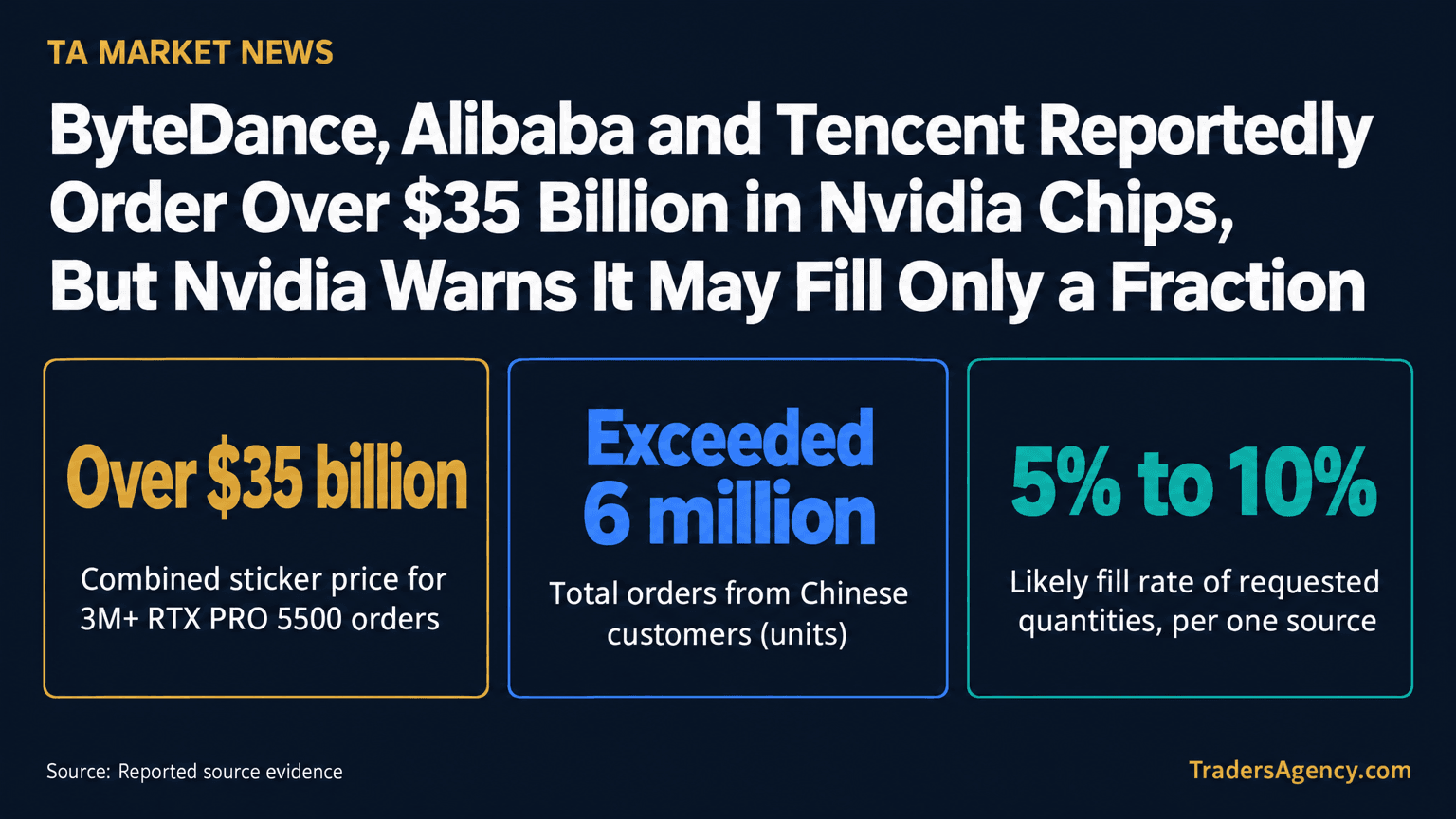
Using the figures Reuters attributed to its sources, the arithmetic behind the headline dollar figure can be checked. Reuters reported the three companies' orders are for cards priced at about $11,400 each, with orders exceeding 3 million units. At exactly 3 million units, 3,000,000 × $11,400 equals $34.2 billion, our calculation; reaching Reuters' "over $35 billion" figure would require roughly 3.07 million cards or more ($35 billion ÷ $11,400 ≈ 3.07 million), which is consistent with the report's description of orders totaling "more than 3 million" units.
A second comparison worth drawing, using two figures both attributed by Reuters to its sources, is the gap between total Chinese demand and Nvidia's stated production ceiling. Reuters reported total orders from Chinese customers exceeding 6 million units against a global 2027 production cap of no more than 3 million units cited by one source, implying that even before accounting for demand elsewhere, China-only orders could already absorb the full planned supply twice over, our calculation based on those two Reuters-sourced figures. That tension helps explain, though does not fully reconcile with, the sharper 5% to 10% fill-rate warning attributed to a different source in the same report; a 5% to 10% fill of 6 million units would imply roughly 300,000 to 600,000 cards actually delivered (6,000,000 × 0.05 and 6,000,000 × 0.10), a markedly smaller number than the 3-million-unit production figure cited elsewhere in the report. Reuters did not reconcile these two figures, and neither do we; we flag the discrepancy as a feature of the sourcing rather than a resolved fact.
Any read-through to Nvidia's broader China revenue trajectory remains speculative at this stage. The report describes order requests and a supply warning relayed through unnamed intermediaries, not confirmed shipments, recognized revenue, or an official Nvidia production commitment. Readers should treat the $35 billion figure as a measure of order-book demand at list prices rather than a forecast of sales Nvidia will book.
Bottom Line
Reuters reports that Chinese tech giants have ordered far more Nvidia RTX PRO 5500 chips than Nvidia says it can supply, with one source putting the likely fill rate as low as 5% to 10%. The story illustrates strong latent demand for even export-compliant Nvidia hardware in China, but it rests on anonymous sourcing, lacks confirmation from Nvidia, ByteDance, Alibaba, Tencent or Chinese and U.S. regulators, and leaves open exactly how the reported 6-million-unit demand figure squares with the reported 3-million-unit production ceiling. Investors should watch for any official confirmation or contradiction from Nvidia or the three Chinese companies before treating the figures as settled.
DISCLAIMER: Traders Agency does not offer financial advice. The information provided is for educational purposes only and should not be considered financial advice. Traders Agency is not responsible for any financial losses or consequences resulting from the use of the information provided. Trading carries inherent risks and may not be suitable for all individuals. You are advised to conduct your own research and seek personalized advice before making any investment decisions, recognizing the potential risks and rewards involved.
- Reuters via Euronext: Exclusive-ByteDance, Alibaba, Tencent place over $35 billion worth of Nvidia chip orders · accessed Oct 20, 2026
- finance.yahoo.com: Nvidia Reportedly Sees Alibaba, ByteDance, Tencent Order $35B In RTX PRO 5500 Chips Amid US Export Curbs · accessed Oct 20, 2026
- news.bloombergtax.com: China Firms Order $35 Billion in Nvidia Chips, Reuters Says (1) · accessed Oct 20, 2026
- www.youtube.com: - YouTube · accessed Oct 20, 2026
- www.tradingview.com: Nvidia Reportedly Sees Alibaba, ByteDance, Tencent Order $35B In RTX PRO 5500 Chips Amid US Export Curbs · accessed Oct 20, 2026
- news.bloomberglaw.com: China Firms Order $35 Billion in Nvidia Chips, Reuters Says (1) · accessed Oct 20, 2026
- www.nvidia.com: NVIDIA GTC 2027 Returns to San Jose: Registration & Updates · accessed Oct 20, 2026
- blogs.nvidia.com: Sparks Fly: NVIDIA Accelerates Local AI at IFA 2026 · accessed Oct 20, 2026
See more from Traders Agency on Google
Make us a preferred source and our market analysis will appear more prominently in your Google Search, Top Stories, and AI results.
Add to Preferred Sources