
Bristol Myers Squibb said its Phase 3 ALOFT-IPF trial of admilparant met its primary endpoint at the 60 mg dose, with the drug showing a statistically significant improvement over placebo in lung function decline at Week 52 in patients with idiopathic pulmonary fibrosis (IPF). The higher 120 mg dose slowed the same measure but did not reach statistical significance, according to a Business Wire release carried by MarketMinute.
What the Trial Found
ALOFT-IPF was a multicenter, randomized, double-blind, placebo-controlled study that tested 60 mg and 120 mg doses of admilparant, taken twice daily for at least 52 weeks, against placebo on a 1:1:1 basis, per the release. The primary endpoint was absolute change in forced vital capacity (FVC) from baseline to Week 52. Bristol Myers Squibb said the 60 mg arm achieved a statistically significant improvement in FVC decline versus placebo, while the 120 mg arm slowed decline without reaching significance. The company did not disclose the specific FVC magnitude in milliliters for either dose in the released material, nor did it provide numeric discontinuation or adverse-event rates. It said only that discontinuations due to adverse events were low and similar to placebo across both admilparant arms, and described the overall safety profile as well tolerated.
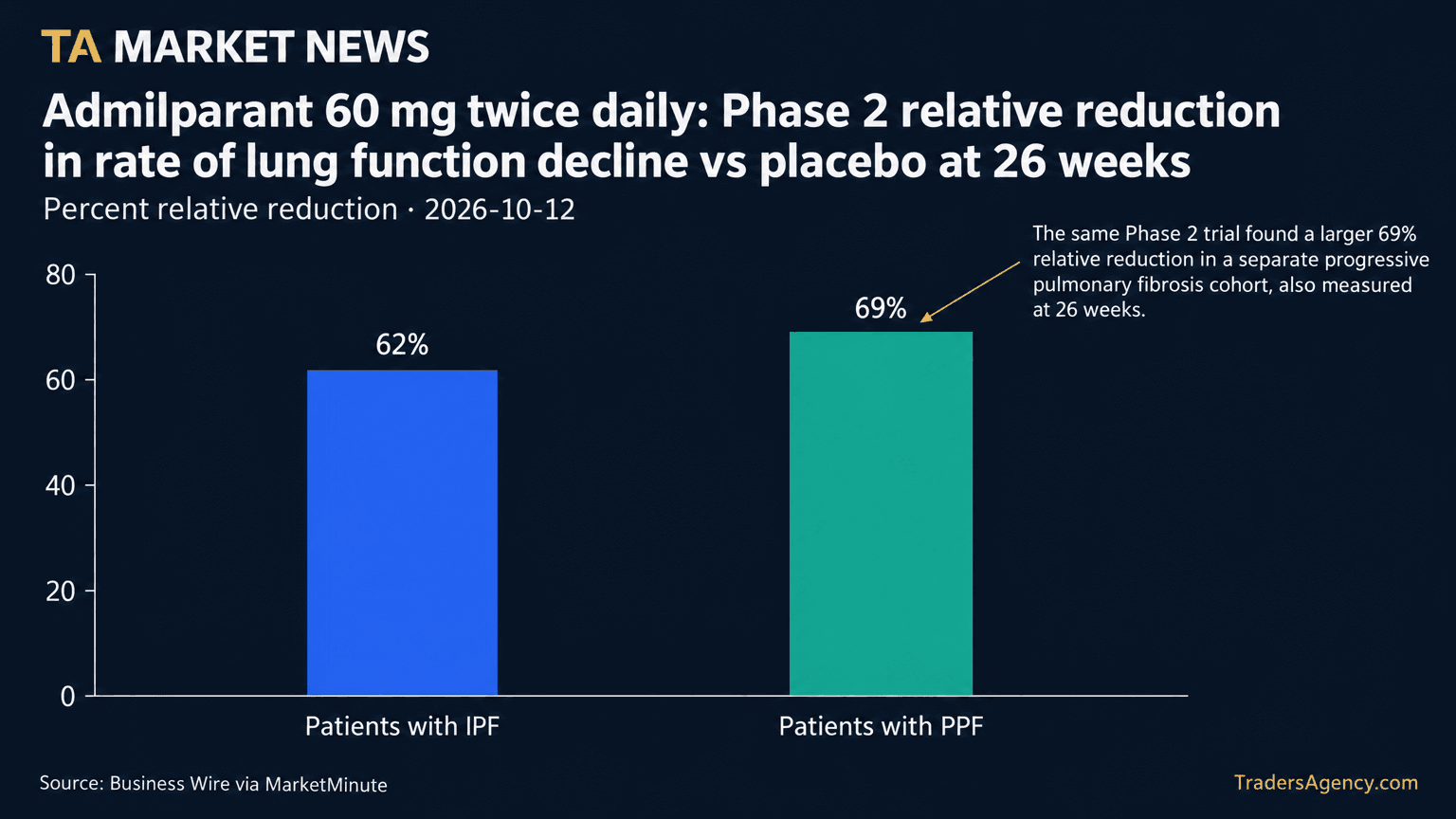
For context on scale, a Phase 2 trial with parallel IPF and PPF cohorts had shown that 26 weeks of admilparant 60 mg twice daily produced a 62% relative reduction in the rate of lung function decline versus placebo in IPF patients and a 69% relative reduction in progressive pulmonary fibrosis (PPF) patients, according to the release. Trial-listing site WithPower separately described patients on the 60 mg dose experiencing a 69% slower decline in lung function over 26 weeks versus placebo. By our calculation using the two Phase 2 figures in the release, the PPF reduction exceeded the IPF reduction by 7 percentage points, a 10.1% relative difference (69 minus 62, divided by 69, times 100) — an arithmetic comparison of two separate patient cohorts rather than a head-to-head result. That comparison also reflects the earlier, shorter Phase 2 dataset rather than the newly reported Phase 3 topline figures, which were not broken out numerically in the release.
How It Stacks Up Against Existing and Rival Therapies
The two currently approved IPF therapies, Boehringer Ingelheim's nintedanib (Ofev) and Genentech's pirfenidone (Esbriet), only modestly slow disease progression and carry significant tolerability problems, according to PatientCare Online and pipeline tracker LarvolDelta. That backdrop is part of why Bristol Myers Squibb positions admilparant's mechanism, an oral, selective antagonist of the lysophosphatidic acid receptor 1 (LPA1), as a potential first-in-class antifibrotic approach, per the release; LarvolDelta similarly groups the drug among next-generation inhibitors aimed at upstream signal-initiation points.
PatientCare Online also reported that United Therapeutics' Phase 3 TETON-2 trial of inhaled treprostinil showed a placebo-adjusted absolute FVC improvement of 95.6 mL at Week 52 in IPF patients without pulmonary hypertension, giving one comparable late-stage benchmark in the same disease population, though it is not a direct head-to-head with admilparant. The broader IPF pipeline has also produced notable setbacks: FibroGen's pamrevlumab failed to meet its primary endpoint in Phase 3, and Pliant Therapeutics' bexotegrast missed in a Phase 2b/3 trial, per PatientCare Online and LarvolDelta.
Executive Reaction and Unmet Need
Cristian Massacesi, Bristol Myers Squibb's chief medical officer, said in the release that the data "reinforce the profile of admilparant as a promising, clinically meaningful investigational therapy for IPF" and reflect the innovation of targeting the LPA1 pathway as a first-in-class approach. Fernando Martinez, chair of the ALOFT program's clinical steering committee, said the results address a continuing need for IPF therapies that are both effective and tolerable, according to the same release.
Bristol Myers Squibb framed the disease burden as substantial, saying roughly 1.4 million people live with IPF globally and that pulmonary fibrosis carries a median survival of three to five years following diagnosis and a five-year survival rate of approximately 45%, with very few new therapies approved in more than a decade. PatientCare Online's independent account put the prognosis somewhat worse, citing a median survival of three to four years at diagnosis and a five-year survival rate of 20% to 40%, alongside roughly 50,000 new U.S. cases diagnosed annually. The two sets of figures differ in degree but agree that outcomes remain poor.
What Comes Next
Bristol Myers Squibb said it will complete a full evaluation of the ALOFT-IPF data and engage with health authorities to support planned regulatory submissions, with detailed results to be presented at a future medical meeting. The release did not specify a submission date or target market, and no peak-sales estimate for admilparant was included in the material reviewed. A companion Phase 3 trial, ALOFT-PPF, is fully enrolled in progressive pulmonary fibrosis, with topline results expected in early 2027, per the release. ALOFT-IPF enrolled approximately 1,255 adults and ALOFT-PPF approximately 1,057 adults, a difference of 198 participants, or about 18.7% more in the IPF study, by our calculation based on the enrollment figures in the release.
The release carried a standard cautionary note that future study results may not be consistent with results reported to date and that admilparant may not ultimately receive regulatory approval for the indications described.
Bottom Line
Bristol Myers Squibb's ALOFT-IPF data give the 60 mg admilparant dose a statistically significant win on the trial's primary endpoint, while the 120 mg dose fell short of significance despite also slowing lung function decline. The company has not yet disclosed the numeric size of the FVC benefit, detailed safety rates, or a regulatory filing timeline, leaving the practical clinical and commercial implications contingent on the fuller dataset the company says it will present at a future medical meeting.
DISCLAIMER: Traders Agency does not offer financial advice. The information provided is for educational purposes only and should not be considered financial advice. Traders Agency is not responsible for any financial losses or consequences resulting from the use of the information provided. Trading carries inherent risks and may not be suitable for all individuals. You are advised to conduct your own research and seek personalized advice before making any investment decisions, recognizing the potential risks and rewards involved.
- Business Wire via MarketMinute: Bristol Myers Squibb Announces Phase 3 ALOFT-IPF Trial Evaluating Admilparant in Adults with Idiopathic Pulmonary Fibrosis Met Primary Endpoint · accessed Oct 12, 2026
- medcommsvdp.web.bms.com: Design and rationale for a phase 3 trial of admilparant ( ... · accessed Oct 12, 2026
- delta.larvol.com: admilparant (BMS-986278) / BMS · accessed Oct 12, 2026
- www.withpower.com: Admilparant for Pulmonary Fibrosis · accessed Oct 12, 2026
- www.patientcareonline.com: The IPF Pipeline is Set to Deliver: The 3 Top Contenders · accessed Oct 12, 2026
- www.bmscongregate.com: American Thoracic Society (ATS) · accessed Oct 12, 2026
- medcommsvdp.web.bms.com: ALOFT-PPF · accessed Oct 12, 2026
- www.bms.com: Bristol Myers Squibb - Global Biopharmaceutical Company · accessed Oct 12, 2026
- www.bms.com: Investors - Bristol Myers Squibb · accessed Oct 12, 2026
See more from Traders Agency on Google
Make us a preferred source and our market analysis will appear more prominently in your Google Search, Top Stories, and AI results.
Add to Preferred Sources